The Kaleidoscope
the complexity of living in rural Italy
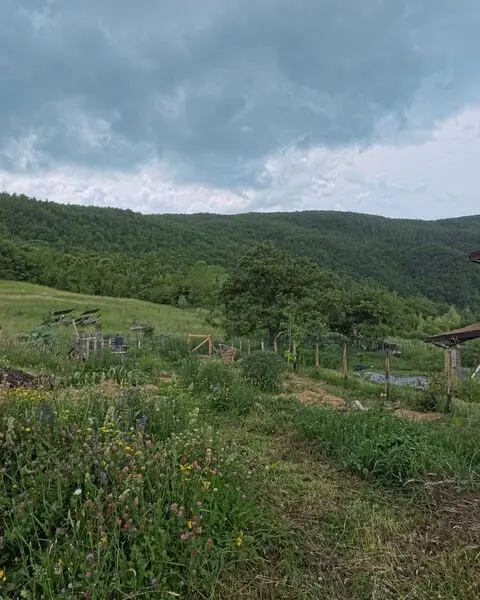
It’s a gray, rainy Monday morning. I woke up with too much noise in my mind. The house has been quiet, only a few barks from the dogs that spotted some deer at the entrance of the forest, far on the corners of our field.
Cuchita, the sovereign cat, is laying on the table next to the computer where I’m typing this.
I’m feeling overwhelmed, this house asked so much of us and I’ve been getting more and more tired suffering with back, belly and chest pain since we had our wedding here. I have a lot of vitality within me still, the beauty and the complexity of living here enriches me as much it depletes me.
Yesterday I saw a video of us, an interview we did more than a year ago for a European project called Eutopia. As I was watching it, I saw what was hidden in plain sight: in my body and the way I’d carry myself, there was overwhelm, fear, confusion and loneliness. I was trying to hold it all together. I deeply respect what we’ve been through but I don’t romanticize or want to re-live anything that happened.
Last week, I struck up a conversation with a woman at the farmers market. She mentioned that where we live now feels worlds apart from her previous home in Rome, despite being just two hours away.
“Look at Italy’s landscape: it’s made to create completely different pockets of cultures!”
She pointed out how Italy’s unique and diverse geographical landscape harbors so many different micro cultures that have far different habits and ways of interacting with the world around.
In fact, from an outsider perspective Italy is often imagined as a uniform paradise of rolling hills and sun-drenched coastlines, but its reality is far more complex. Italy’s geography is a so diverse: tall mountains, unique coastlines, lakes, flat lands and forests carve the country into distinct geographical pockets. Because communities were historically separated by formidable mountain ranges, dense forests and unique costal areas, they developed in isolation. This isolation transformed geographical boundaries into cultural ones, turning this country into a collection of mini-nations, each with its own language, culinary philosophy, and worldview.
For me, even as a native Italian, relocating here proved to be a surprisingly unfamiliar experience, just as it has been for my Swedish partner.
The area we settled in is in the center, where the Apennine mountain range runs like a rugged spine, acting as a massive wall that historically made traveling east-to-west incredibly difficult. We’re nestled among mountains and forests, and this type of terrain formed a hyper-local mindset. Here, the micro-culture it’s quite reserved and oriented to secure (and sometimes to hoard) natural resources. The main traditions revolve around the earth: mushroom hunting, olive picking, truffle foraging and wild animals' hunting. Each town has its own festivities, traditions and ways of interacting with the external world.
I was born in the north of Italy, where the flat, foggy plains of the Po Valley hosts a very different mindset and attributes than that of those living here in the center. I deeply value the differences and richness of the various cultures and local traditions of this country. Yet, the contrast of our history often creates a barrier to connection. I’d find myself searching for places or people where I'd feel understood without needing to please others abandoning my values, but it has been difficult to meet people who shares or understands our history of travelling or the unique experience of launching and cultivating a project like this.
In our search for the right place to root this project in, we moved more than anyone we’ve ever known. Along the way, we lived through the striking contrasts of Europe: from the vibrant communal life of Northern Spain, to the quiet efficiency and hyper independence of the Swedish culture, to the gentle warmth of Portuguese hospitality. I deeply value our rich background but I’ve frequently wished for a deeper sense of understanding from the community around us. Our vastly different life journeys have made that kind of connection feel out of reach.
I've searched for that sense of belonging in places and people who weren't able to cultivate it with me. To only realize I just didn't have the capacity to forster it within.
Belonging is a feeling that actually begins within and can be fostered through noticing how my body feels in the present moment rather than looking for it in others. Community is important to thrive and live a fulfilling life yet, the connection I long for has to be sustainable in the long run, it’s not rooted in overextending, abandoning myself and people pleasing to belong.
Looking back on these years of unsettling relocation and building this project from the ground up, I realize my nervous system was in survival mode. Sensing that the locals were reserved and skeptical of foreigners, I instinctively tried to make myself as agreeable as possible, fawning to build trust to ensure we'd have help if we ever needed it.
In the process, I constructed an identity built entirely on over-extending and abandoning myself, sacrificing my own needs and boundaries to be someone who only gives and never disrupts, desperately trying to prove I was trustworthy, generous and harmless.
After years of pleasing and exhausting myself, my body rebelled, forcing me to confront both my own exhaustion and the social landscape around me.
My partner, on the other hand, has been loyal to his own integrity, not overextending and always focused on the projects he set himself to pursue.
Our different modalities of approaching this project of living off-grid, generate a lot of friction in our relationship. My nervous system response was oriented socially to secure a sense of belonging in the community at the dispense of my own boundaries, while he would refuse to accept any fawning behaviours, exposing my scarcity mindset and challenging me to stop people-pleasing.
That way of interacting wasn't effective at all. I would collapse, jade up or run away. He'd feel frustration and inefficiency.
All that we’ve been through served me to realize that the world has plenty of space for me. That I don’t need to abandon myself to feel that I belong. Inconveniencing others might feel uncomfortable at times, but it’s nothing compared to the devastating cost of abandoning myself. That people sense and feel the motives and intentions behind interactions, that my body was always giving me clues and opportunities to pivot.
Anchoring in my own body, inhabiting it fully, is the foundation for that sense of belonging to bloom and to be able to enter in connection with others humans in a sustainable way.
I definitely regret to have spent so much time building the identity of the “good, harmless girl” and I also know that all of that was part of my journey. Being confronted with the barren realization that what I’ve been clinging on wasn’t actually working has been quite complex to navigate but I’m very excited for what is emerging.
Now I’m slowly and curiously exploring what it actually means to be here from a rooted, unapologetic and fierce center.